Saturday, December 7, 2013

Leveraging Marketing Funnels for User Experience


Marketing funnels are a natural fit to user experience design, so natural in fact that it's often assumed that UX designers already understand what a marketing funnel is and how it can be leveraged to optimize user experience.   Unfortunately, I've received a few "what's that?" reactions and failed to find a good reference online - and worse, saw a few references that botched the explanation - and so I figured it was worthwhile to put together a blog post.

Marketing Funnel Basics

A marketing "funnel" measures the number or percentage of people who were subjected to an initial stimulus (usually an advertisement) that eventually made a purchase, noting the number of people who dropped out at each step along the way: how many fliers were mailed out, how many people came to the store on sales day, how many people visited the right department, how many bought the advertised item, how many kept it, and how many bought it a second time afterward.   Here's an example:
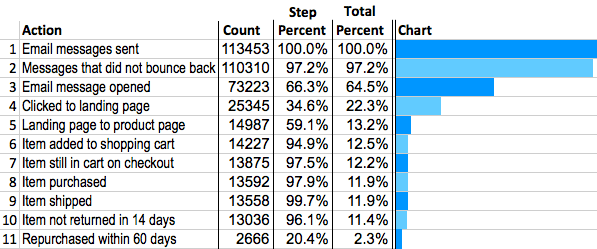

It's called a "funnel" because if you center the bars and smooth the edges, it looks like a kitchen funnel - which makes a very nice PowerPoint graphic, but a bar chart works just as well.

From the example above, you can see the way that a prospect becomes a regular customer - and more importantly, you can see places in the funnel where a larger proportion of customers drop out.   These become areas where improvement could significantly increase your success rate and help you spend your budget in the right place.   For example, if you have a big drop-out rate between purchases and product retention, it means there is a problem that causes your customers to return the item after buying it, and you should focus your effort there instead of driving more customers into a broken flow.

Building a Funnel

Building your own funnel is fairly straightforward: you begin with an initial incident (where you first grab the attention of a prospect) and follow them each step along the way to the end.   For example, if you are running an online promotion for a specific item, the steps would be:

  1. Number of people saw the promotion (ad impressions)
  2. Number of people visited your site (click-through rate)
  3. Number of people visited the product information page
  4. Number of people added it to a shopping cart
  5. Number of people's carts was it in at check-out
  6. Number of people checked out with the item
  7. Number of people kept the item (did not return for refund)
  8. Number of people came back 30 days later and bought another

Depending on how closely you measure user activities, you can also define additional steps in the funnel.  For example, if you record when someone chooses a color before adding the item to the cart, you might find some value in measuring the number of people who did so (as a step between visiting the product page and adding it to a cart).   Or if a page asks seven questions, you can find out how many people answered each question before dropping out, which pinpoints the source of the problem with much greater accuracy rather than just measuring page-by-page clicks.

It's Not Just for Sales

Marketing funnels were created to track the effectiveness of sales promotions, and are by their nature focused on purchases - but they can be used to track any sort of user engagement that you wish to consider.   For example, consider using a Facebook post to get people to subscribe to your new Twitter feed.  That funnel might look something like this:

  1. Number of people who viewed the Facebook post
  2. Number of people who clicked the link to Twitter
  3. Number of people who followed the Twitter feed
  4. Number of people still following the feed after 60 days

Granted, your ultimate goal is likely to sell them something - but for now, your primary goal is to get them to subscribe, and it would likely be useful to create a different funnel that tracked users afterward, to see how many people who received a given twitter post and then stepped into your selling funnel.

One other thing bears remarking: the funnel above did not include Facebook "likes."   It's interesting to track those, but keep them separated because it is not a necessary step in reaching the end of this particular funnel: a person can like to post but not subscribe to the feed, or click through and subscribe to the feed without liking the post, so that factor would be very misleading.

Caveat Vendor

While marketing funnels can be highly informative and enable you to identify (and hopefully eliminate) causes of friction in your conversion flow, there are a few limitations you should consider:

First, the path you expect customers to follow is not the path they always follow.   In the brick-and-mortar world, a deli might notice a huge jump in their sales of potato salad on a Saturday when they ran a sale - but might be entirely unaware that it just so happened that two large neighborhood churches were having a Sunday picnic that weekend, and the spike in demand may be more attributable to the picnics than the advertisement.  Online this is fairly easy to remedy by checking the referring URLs to a page and cleaning out people who wandered in from other sources or deep-dived into the middle of your anticipated flow.

Second, you cannot assume that percentages will remain consistent - that is, if you can run an advertisement to get 10,000 more customers to visit and your conversion ratio is 14%, that will not automatically mean 1,400 additional sales.  The ad may have been targeted to the wrong audience, or (unintentionally) misleading, such that every one of those 10,000 "customers" will drop out immediately.  This doesn't mean the funnel is broken, but that your advertisement was in some way defective.

Third, many marketing funnels end with a sale.   In the example above, I included two additional steps.  First, I also included the number of items sold and not returned within seven days.  To me, that makes a great deal of sense to monitor because a product returned is not really sold, and any action you take that increases sales but also returns is awful - and unless you account for returns you will never recognize your mistake.    Second, I also show a number of repeat buyers, which is highly significant if your goal is to grow your customer base rather than make a one-time sale to people who might be so disappointed they never purchase again.

Working Your Funnel

Having an idea of where in your flow the customer is dropping out is very valuable to knowing where design attention is needed to improve your bottom line - and watching your funnel change over time (or in testing version of a given design by splitting the audience) will give you demonstrable proof of the effectiveness of your design changes.

Without a funnel, you can only speak in vague terms about the new design being "better" than the old one - and we all know how business partners react to statements like "increasing the font size and white space created greater affordance" (i.e., they cock their heads like spaniels, which is cute but doesn't win you much respect).  But once you have funnel metrics in place, you can speak in concrete terms that will resound with your business partners.  

That is, you can say things like "changing the messaging on the product page and improving the location of the add-to-cart button resulted in a 3.7% increase in step-to-step conversion and a revenue increase of $75,645.25 per month."   As boring as it sounds to talk in numbers, this is what wins respect and commands budget allocations - but more importantly, it's what gets more products to more customers, more subscribers to your social media feeds, and more of what you ultimately want to accomplish done.

Tuesday, December 3, 2013

Understanding Emotions

I recently read a primer on understanding emotions, with an eye toward how to leverage them in customer experience.   There's nothing sinister or underhanded on my agenda - but it does seem to me that much of what we do in designing and delivering experiences is geared toward avoiding unhappiness by removing barriers to success and there's very little knowledge of what can be done to promote happiness in a proactive manner.

I don't think I found a solution - but the study of this topic has given me food for thought: mainly, that the default setting for human emotions is a neutral state called "contentedness" in which individuals are neither happy nor unhappy, but quite indifferent to external stimuli in general, being neither elated nor distressed at the goings on in their external surroundings and internal ruminations.

Motivation to act arises when there is an immediate stimulus that causes a change in the contented state.   Pain and discomfort motivate a person to action, whereas pleasure causes them to remain inert and savor the experience while it lasts.   More significant to motivation is the perceived potential for something to interrupt the contented state: the prospect of being subject to pain or the opportunity to experience pleasure prompt an individual to take preventative or proactive measures to avoid one and seize the other.

It is likely significant that both immediate and potential pain is motivational, whereas only potential pleasure is motivational.   Though it can be argued that an individual who is presently experiencing pleasure would be motivated to take action to prolong the experience and forefend against the potential that it will be interrupted or diminished.   I don't have the sense that sustaining pleasure can be entirely equated to avoiding pain, but my sense of now is that they are likely analogous in many ways.

It is also likely significant that emotional reaction (or pre-action) is regarded as being motivational - it provides an inclination to take action but does not govern action itself.   It's generally accepted that emotion hands off to reason when a desire is discovered, such that an emotional reaction causes a person to want to take action whereas reason guides a person in choosing the action to take.

This would seem to indicate that emotion precedes action, such that by the time a customer visits a store or a website, the emotional influence has played its part and the individual is likely now following a course dictated by logic.   And while there has been some consideration of sustaining emotion throughout a sequence of actions, my sense is now that it may be a bit misguided.

More aptly, the emotions an individual experiences while pursuing a course of action are different to those that prompted them to undertake the action in the first place.   These emotions are not reactions to the original stimulus, but to the progress that is being made toward the goal.

That is to say that the emotions experienced while acting are those of engagement and anticipation of an outcome, rather than sustaining the emotion that caused the action to be undertaken - that moment has passed, and the emotion of that moment along with it.

As such a person who is motivated by a sense of discomfort to take action to diminish or terminate those emotions then experiences a different set of emotions as they progress toward their intended goal - they are no longer upset because of the initial discomfort, but anxious about achieving an escape from panic, and that anxiety can express itself as hope or despair that the outcome will be achieved.

This might help to better understand the reason customers ultimately decide not to make a purchase: their engagement in the shopping process, with the anxiety it entails, may distract them from whatever emotional state motivated them to begin shopping in the first place - and if they are significantly distracted by the process, it is no longer necessary to make a purchase to escape the motivational state because the act of pursuit has involved stimuli, the reaction to which as replaced the motivational state with different emotions.

Aside of that, there is the notion of happiness as an ephemeral state - which sheds some light on consumerism and materialism.   In effect, success at a goal that delivers a sustained sensation of pleasure resets the parameters for the contented state.   Gaining something that was acutely desired satisfies desire and conveys a sense of accomplishment, but when "normal" becomes a state in which the desire is satisfied, the subject returns to mere contentment.

Even so, I'm not discouraged in my search for an answer, though I'm beginning to understand that, given the way in which emotions are currently understood, a solution may be difficult to identify.

Friday, November 29, 2013

Testing in the Wild


There is much to be said for testing user experience design in the wild – it has a number of advantages if used properly, but using it properly is something of a delicate matter – but for the moment, I’d like to focus on the various kinds of tests that are run in a production environment, as there seems to be a great deal of confusion among them.  

Aside of being persnickety about calling things by the proper name (many people use “A:B Test” when what they really mean is a multivariate or champion-challenger test), it’s also important to make the distinction so that you can plan the right test to get the information you need and relate the results in a meaningful and accurate way, using each method to its best advantage.

Champion-Challenger Test

A champion-challenger test is the most commonly used variety.   It compares an as-is design to a proposed to-be design to confirm that the desired effect on user behavior is effected.   Consider these two examples:


The “challenger” version of the element has many differences to the “champion” version: the headline is different text, font, and color; the call-to-action button is a different color, a different phrase, a different size, and in a different position; the image is different; and the copy is different.     As such, if you should notice a difference in their performance, you have no idea which of these changes caused the difference to occur.

That’s not necessarily a bad thing – since the ultimate goal is to increase click-through, you likely do not care which of these elements is to credit, so a champion-challenger test effects a one-time improvement but does not “teach” you anything that could be used to improve any future design.

A:B Test

The A:B test is the one most often claimed, but often mistakenly so.   It is misunderstood because the parameters of an A:B test are very stringent: only one thing, and one very specific thing, can be tested. Consider these two examples:


The only difference between them is the color of the button.  If you change anything else about the layout, or even another aspect of the button (the words, the size, or the position), you are no longer running an A:B test but a champion-challenger test, with the combined impact of all changes commingled and inseparable.

The greatest benefit of an A:B test is that it supports not merely a one-time decision (this layout is better than that one) but a general observation (green buttons perform better than blue ones) that is very likely to be applicable across all such layouts on your site, and possibly across multiple sites.

Multivariate Test

A multivariate test combines the best of both worlds: it enables you to make multiple changes to a layout, but test them in such a way that you can identify the degree of influence each change has on the outcome.  Consider these examples:


These four variations test two elements: the wording and color of the button.   By doing so, you can be informed not only that one does better than the rest, but also the influence of each factor.  That is to say that A:B testing might suggest a green button is better than a blue one and “get info” is better than “learn more,” leading you to conclude that a green “get info” button is the best of all – but when you actually test every possible combination, you may discover that the blue “learn more” button outperforms is.

This arises due to covariance, a statistical concept that is best explained as being the combined effect of many different factors, and it is ultimately what is significant to the user, who does not mentally dissect your layout into its component elements but experiences it as a whole, whose impact may be greater or lesser than the sum of its parts.

Multivariate testing yields the same general result as a champion-challenger test, identifying the combination of elements that has the greatest impact for a very specific instance.   And because the influence of each factor is examined, it also has the benefit of providing the general insight that would be yielded by multiple A:B tests of each factor.


Informed Decisions, Informed Interpretations

It is important to make the distinction between types of tests in order to decide which kind of test is appropriate to the information you wish to learn, as well as in knowing whether you can rely on test results to guide future decisions.

For example, if you run a champion-challenger test in which the champion has a blue button and the challenger (which wins) has a green button, you cannot accurately or reliably state that green buttons outperform blue because you do not really know which of several changes effected the difference in outcome.  Sadly, claims of this sort are very frequently made, and the result is proceeding boldly on bad information.

Of importance: consider (and report upon) each test for what it’s actually worth:

  • A champion-challenger test enables you to make an accurate one-time decision but yields no reusable observations
  • An A:B test enables you to make a precise observation that may be too limited or granular to make a practical decision
  • A multivariate test supports both one-time decisions and general observations, plus it tests for covariance among the factors

Thus considered, the multivariate test would seem to be the best of the three in terms of outcomes – but depending on the decision with which you are faced, one of the other two may be more relevant, and so long as you are aware of what the results actually mean, may be entirely acceptable to a given decision-making scenario.

Monday, November 25, 2013

Social Media and Personal Integrity

Social media troubles me less than it used to - it seems to me a matter of personal integrity being stressed in the too-visible world, where everything you say is visible to everyone you know (or at least everyone you have included or who subscribes to your feed) and that certain things are acceptable to share with some audiences but not with others.   It still concerns me, but less than before - and my present thoughts are that it shouldn't concern me at all.

I've never been one of those people who puts on different faces when he interacts with different crowds, and have generally subscribed to the notion that people can take me as I am, or bugger off.   I don't need "friends" who demand that I mitigate my personality in their presence, and I'm really not particularly fond of the kind of person that tailors themselves in order to trick people into perceiving them as something they're not - most people can tell that they are fakes, and no-one likes or trusts them very much.

I still subscribe to the notion that some things are acceptable in some groups but not others.  There are jokes you'd tell a friend that you wouldn't tell an elderly relative, and some things that you can share with close friends but not with more distant acquaintances that don't know you well enough to understand the context.   That's not disingenuousness, but discretion.

But having said that, I realized that I haven't really filtered myself that much.  Years ago I set up groups and lists of people so that I could better direct my posts.   There was a group of "friends and family" with whom I could share more intimate details, and a group called "humorless" from whom I'd withhold any amusing story or any joke that didn't begin with "knock-knock" because I knew they wouldn't get it.   Once I created those lists, I very seldom used them and have not kept them up to date.

I still have that moment's pause before tapping the "post" key when I consider whether what I have provided is of sufficient interest to and appropriate for everyone I know - family, close friends, coworkers, and the like.    And I do have the sense that this prevents me (for my own good) from being too forthcoming.   But again, discretion and disingenuousness are two different things and I can live with the former.

Neither do I feel the need to share every event or thought with everyone: most people just don't care to know me that well.   My sense is that a lot of the more intimate details of my life and some of the more amusing (but questionable) stories are still reserved for face-to-face encounters - and it also suits my sense of justice, as anyone who doesn't care to invest face-time with me doesn't deserve that level of intimacy in a friendship anyway.

I wonder if that's just me ... looking though the posts I see from other people, it really is a mixed bag.  Some people share a lot of information, others share very little.   And to be specific, it's sharing information about themselves, not content that they found in other places that reveals nothing personal except that they happened to find it amusing.

And it's probably not fair to lump everyone who is reticent about themselves into the category of impostors and fakes, but there are a few whom I feel fairly certain that they are trying to present a public image that doesn't match the one that people meet in real life - or at least, some people meet in real life, as people who are false in one channel are likely false in others as well.

I've probably a lot more thinking to do on the topic, but it's shifted a bit over the past few years, and will likely shift a bit futher.

Thursday, November 21, 2013

Ethics and the Mobile Consumer

I heard it said that mobile technology levels the playing field in sales situations by removing the customer's greatest foible: his own ignorance.   That struck a chord with me, because exploiting the ignorance of another person is the basis of many unethical practices, in many situations other than sales - but for now I'll stick to those situations that are related to commercial interactions between deceitful merchants and their victims.

It's likely important to pause for a moment to concede that not every merchant is deceitful.  However, it does figure into the tactics of many, and otherwise honest merchants stoop to deceit when their minds are more focused on satisfying the revenue metrics placed upon them by their management and investors.   There are those who are, at most times, motivated by a genuine interest to serve the needs of customers with the benefits of a good or service - but even the most scrupulous of merchants may pass along their own misinformation.

But to return to the topic: merchants have long been able to count upon the ignorance of the customer, and could make grandiose and patently false claims that the customer, lacking any way to verify or validate the information, tends to accept as valid, or at least play along for various psychological and sociological reasons.

"This product is effective at solving your problem" is a common lie that customers would not discover until long after the sale was final.   "This product comes highly recommended" is another that could scarce be disputed.   Even claims such as "you won't find a better price anywhere else" stand when there is no ability to refute it with facts.

Prior to the Internet, the customer was completely bereft of information.   It was not impossible to conduct independent research, but doing so often meant a trip to the library, poring over periodicals, sending letters to get information.  For the vast majority of purchases, it simply wasn't worth the time and effort required to gather information in advance of visiting a merchant, or to stall a needed purchase until the research could be done.

Even with the Internet, gaining the information required some effort: the customer would have to conduct this research at their home or office, either in advance or in arrears.   But there was still the effort required to gather the information, analyze it, and memorize it - unless you wanted to carry a stack of notes and print-outs and knew exactly what you needed in advance.   Even then, it's a very simple matter for a liar to invent a different lie, and cause the customer to have to do additional hours of research to confirm.

But with mobile, the information resources are portable: the customer can bring their device with them to the sales floor and reference whatever information is needed in that location.  There's still some degree of effort necessary to retrieve the information, as it is dispersed in various sources, buried in passages of text that are too lengthy to consume on the small screen, and search engines still aren't very good in spite of decades of effort to improve them.

And so, when a merchant claims that a product is effective, the mobile-empowered customer can find evidence to support or refute the claim.   When the merchant claims the product is recommended, the customer can verify whether this is true.  When the merchant claims to offer the best price anywhere, the customer can pretty easily check up on that assertion.

The ability to reference and validate empowers the customer to overcome his ignorance and the deceit of merchants at any time, and in any medium - whether he is negotiating with a live salesman, considering an advertising message, or even reading the claims printed on a package as he is considering an in-store purchase.

Moreover, I expect that this will become even easier over time: what's needed is software that enables the customer to scan a bar-code or type in the name of a product or vendor to retrieve reliable information relevant to the product's functions, qualities, values, price, and other qualities that are germane to making a purchase decision in a format that is easy to use and easy to consume on the mobile platform.

To my knowledge, that does not yet exist, though several different firms have attempted to provide a solution, none of them are entirely satisfactory for various reasons - but again, I expect with time and effort, this will improve.    But even now, there are enough sources of information that only a few minutes (well, maybe ten or fifteen) are required to gather sufficient information to be adequately confident in whether a claim or belief about a product is true or false.

And in the end, this is likely a good thing: many merchants live in fear of  the informed customer - or more aptly, they lived in fear of the customer who could easily disprove the lies that they routinely tell to get revenue to which they are not entitled.   Those who were honest in their claims and fair in their dealings never had any reason to worry, and still do not - and ultimately, if the honest merchants prevail and the deceitful ones perish, that's likely a good thing for everyone.